The Peace Summit Without Peace
Trump and el-Sisi will co-chair the “Sharm el-Sheikh Peace Summit.” Israel is staying home. Hamas and the Palestinian Authority weren’t invited.

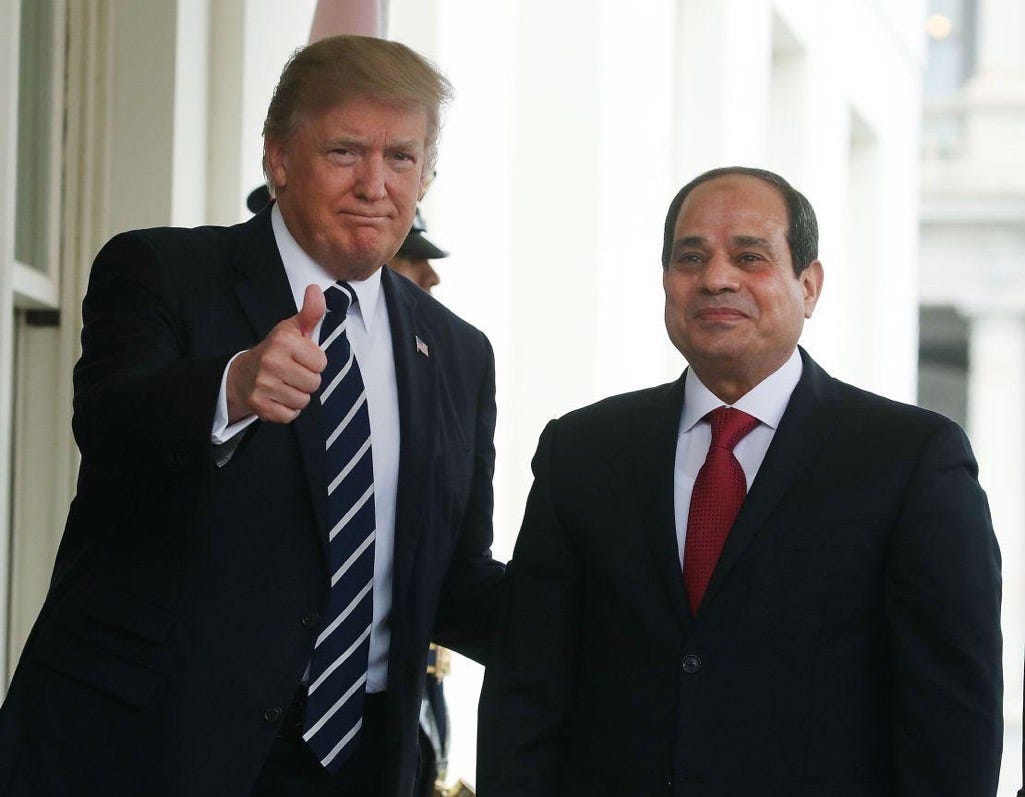
The ink on Donald Trump’s Gaza ceasefire deal is barely dry, yet the next act of this fraught drama unfolds. On Monday, October 13, 2025, world leaders will converge in Sharm el-Sheikh, Egypt, under the banner of “peace.” The guest list boasts presidents, princes, and power brokers from over 20 nations, but the people whose lives have been shattered by this war are nowhere to be found.
Israel, the conflict’s central belligerent, will not send Prime Minister Benjamin Netanyahu or any delegation. The Palestinian Authority has been explicitly snubbed, despite requests for talks, and Hamas wasn’t even considered. Even as Palestinian leaders like Mahmoud Abbas praise the deal’s “sincerity,” their absence, coupled with Hamas officials’ insistence on Palestinian-led governance via national consensus with factions and the PA, ensures Gaza’s future is shaped without their voice. This isn’t a peace summit; it’s a summit about peace, staged without the Palestinians or their occupier.
U.S. President Donald Trump and Egyptian President Abdel Fattah el-Sisi will preside, joined by Gulf states who watched Gaza burn for two years from the safety of their palaces. Saudi Arabia, Qatar, and the UAE, with their vast oil and diplomatic leverage, offered cautious statements after Israel assassinated Hamas leader Ismail Haniyeh in Tehran in July 2024, but nothing like the outrage that followed when Israel struck Doha. That attack, unlike the one in Iran, sparked fear of their own vulnerability. Within days, they rallied behind Trump’s ceasefire plan, not out of compassion for Gaza, but to contain a war threatening their own stability. Once set on Hamas’s obliteration, they now seek its pacification, a quiet Gaza, and regional calm they can claim as their own.
The U.S. has invited an eclectic mix, Spain, Japan, Azerbaijan, Armenia, Hungary, India, El Salvador, Cyprus, Greece, Bahrain, Kuwait, Canada, and even Iran’s President Masoud Pezeshkian, though sources close to Tehran dismiss it as a U.S. PR stunt, casting doubt on his attendance amid decades of hostility. What began as a regional peace conference has ballooned into a geopolitical photo op. Each new participant dilutes the focus on Gaza’s future, exposing the summit’s real purpose: not to resolve the conflict, but to let leaders claim credit for pretending to shape it.
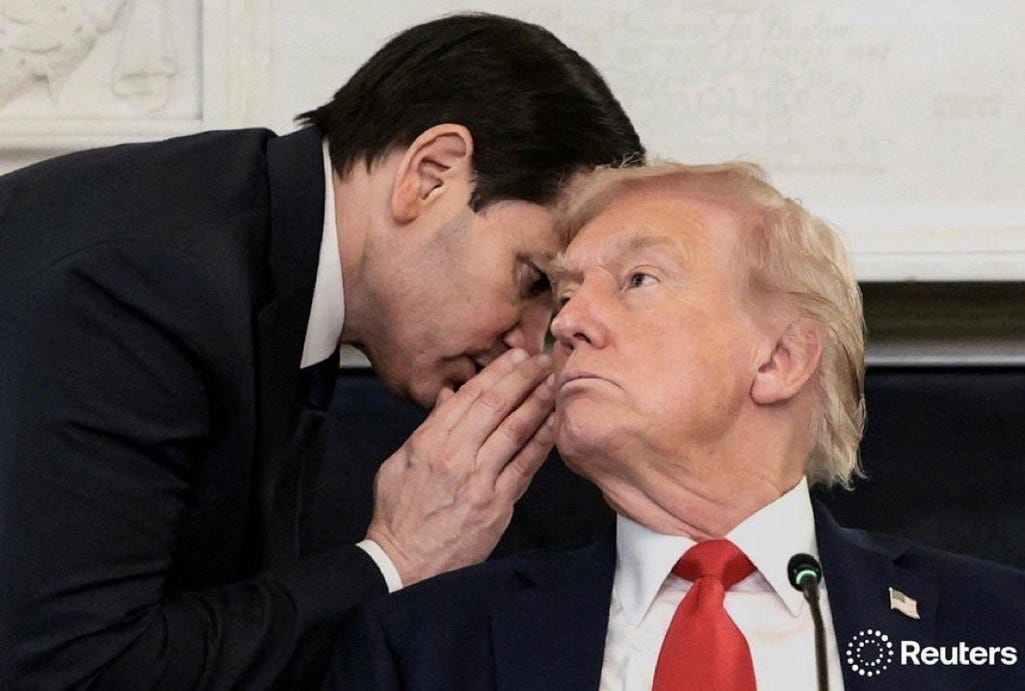
The optics will be immaculate: Arab unity on display, American leadership trumpeted, applause lines about “rebuilding Gaza” delivered with gravitas. Yet nothing fundamental will change. Israel still refuses to commit to a full withdrawal, maintaining its grip on Gaza in all but name. The “new Gaza” envisioned in Trump’s plan, with a U.S.-led aid center and foreign oversight, will rest on conditional aid and military supervision, amounting to custodial management under occupation and despite. Hamas, for its part, rejects disarmament under occupation, offering instead to fold its fighters into a national Palestinian force only after statehood. A peace that feels more like custody than liberation.
What unfolds in Sharm el-Sheikh will shape Gaza’s “day after.” It will decide whether the territory’s future belongs to its people or to a or to a consortium of donors, generals, and billionaires far removed from its rubble.
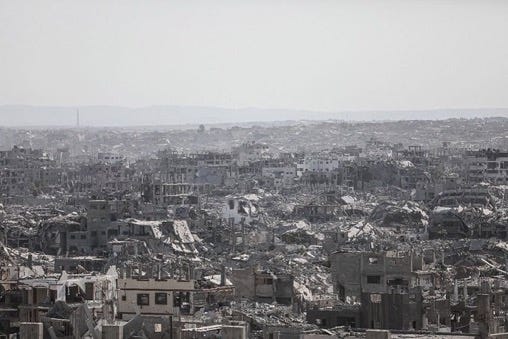
Look closely at the ruins of Khan Younis, once a vibrant city pulsing with life, laughter echoing through bustling markets, families gathering in homes filled with stories, and children playing in streets that carried the weight of Palestinian history. Now, it lies in rubble and dust, reduced to a desolate wasteland. Israel’s relentless bombardment didn’t merely destroy homes; it obliterated entire neighborhoods, erasing the tangible proof that Palestinians lived, loved, and belonged here. The scars of Khan Younis, where 80% of buildings are now rubble, and over 100,000 people remain displaced, bear witness to a campaign not just of warfare, but of annihilation.
Gaza hasn’t been destroyed; it has been deleted. This erasure of a people’s past and presence is what the Sharm el-Sheikh summit on October 13, 2025, conveniently sidesteps. While world leaders gather to draft Gaza’s “day after,” the voices of those whose cities have been reduced to dust, like the residents of Khan Younis, are absent. Without acknowledging this loss, the summit’s promises of peace ring hollow, a cruel mockery of a land stripped of its history.
What unfolds in Sharm el-Sheikh will shape Gaza’s “day after.” It will decide whether the territory’s future belongs to its people or to a committee of donors, generals, and billionaires far removed from Khan Younis, where 80% of a once-vibrant city, its homes, markets, and stories, lies erased, proof of Palestinian life deliberately reduced to rubble.
What unfolds in Sharm el-Sheikh will shape Gaza’s “day after.” It will decide whether the territory’s future belongs to its people or to a committee of donors, generals, and billionaires far removed from Khan Younis, where 80% of a once-vibrant city, its homes, markets, and stories, lies erased, proof of Palestinian life deliberately reduced to rubble.
They’ll call it peace. But without sovereignty, justice, or accountability for the 67,000 lives lost and millions displaced, every frame of this devastation and hospitals like Al-Rantisi bombed is a crime scene, a ceasefire dressed up with better lighting
.
Ignore the noise, Hala. Juvenile responses reveal more about the commenter’s insecurity than your argument, which exposes what they’d rather ignore. It takes courage to write truth in an age that rewards performance. Keep going; the world needs that clarity more than ever.